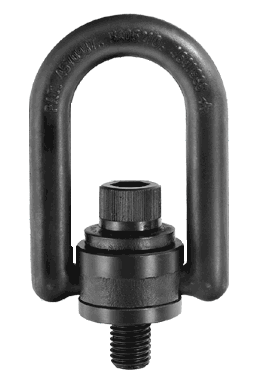
Safety should always be a concern when working with hoist rings. Some of
the safety practices that must be observed are obvious, such as never
exceeding the rated capacity of the hoist ring. However, other concerns
may not be as readily apparent. The following are a few general safety
considerations to keep in mind when utilizing hoist rings to lift any
workload.
-
When installing hoist rings, the
mounting surface MUST be flat and smooth to ensure full contact
between the hoist rings mount and the tool body.
-
Threaded mounting holes should
always be tapped perpendicular to the mounting surface.
-
For proper mounting of hoist rings
with tapped holes, the material used for the tool body should have a
tensile strength of at least 80,000 psi.
-
When installing, the mounting base
of the hoist ring should be mounted directly to the tool body.
Spacers, washers or similar devices should NEVER be used.
-
Mounting screws should always be
tightened to the recommended torque specifications.
-
For long-term use, the torque of the
screws should be checked periodically to make sure screws have not
loosened in use.
-
Once the hoist ring is installed, as
a final check, always make sure the rings rotate and pivot freely in
all directions.
DO:
-
Always read safety precautions
information prior to use or installation.
-
Always inspect the hoist ring(s)
before use.
-
Regularly inspect all hoist ring
parts.
-
Always tighten the screws to the
recommended torque.
-
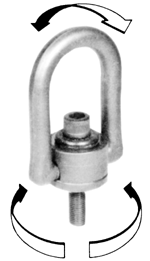
Make sure that the hoist ring is
free to pivot in all directions.
-
Choose a hoist ring with the proper
load rating.
-
Always make sure the thread
engagement is at least 1.5 times the diameter of the hoist ring screw.
-
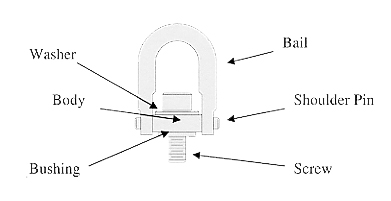
Make sure that the hoist ring
bushing sits flush against the object being lifted.
-
Consider periodic load-testing as an
added precaution.
DON'T:
-
Never exceed the rated load.
-
Never use a hoist ring that you
believe might be damaged.
-
Do not use a hoist ring with damaged
screw threads.
-
Never use in an application that
does not allow the hoist ring to pivot and swivel in every direction.
-
Never use a hoist ring that is not
tightened to the recommended torque.
-
Never replace parts/components of
the hoist ring with anything but parts from PS&E.
-
Never utilize a hook larger than the
diameter of the opening.
-
Never shim or use washers between
the hoist ring and the surface of the object being lifted.
Hoist Ring Load
Example:
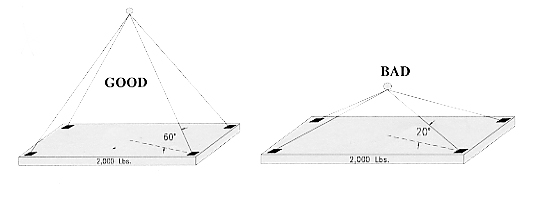
The load of each ring is not simply an
equation of total weight divided by the number of hoist rings. The
resulting force can be greater at shallow lift angles and with uneven
loads. See the table below for examples.
|
LIFTING ANGLE
(DEGREES) |
NUMBER OF
HOIST RINGS |
WEIGHT OF LOAD
(POUNDS) |
ACTUAL APPLIED LOAD
(POUNDS) |
|
90 |
4 |
2,000 |
500 |
| 80 |
4 |
2,000 |
510 |
| 70 |
4 |
2,000 |
535 |
| 60 |
4 |
2,000 |
580 |
| 50 |
4 |
2,000 |
655 |
| 40 |
4 |
2,000 |
780 |
| 30 |
4 |
2,000 |
1,000 |
| 20 |
4 |
2,000 |
1,465 |
L = Load weight experienced
by hoist ring
W = Total weight
N = Number of hoist rings
A = Lift angle
|
|
W |
|
|
| L |
= |
|
|
|
|
|
N sin A |
|
|
|
|
|
|
|
|
|
If A |
= |
60: |
|
|
|
|
|
|
|
| L |
= |
2,000 |
= |
577 lbs. |
|
|
|
|
|
|
|
4 sin 60 |
|
|
Click
here for more information on PS&E Hoist Rings
|
|